
UAB Medicine is a leading center for aortic care in the Southeast and one of the busiest in the country. We’re known for comprehensive patient care, innovative treatment options, and contributions to aortic disease research and education.
The Comprehensive Aortic Program is built on a multi-specialty approach to aortic disease and cardiac care, involving experts in cardiac surgery, vascular surgery, cardiology, genetics, and radiology. We deliver the highest quality of patient care, with an emphasis on aortic disease management, evidence-based medicine, and a patient-centered approach.
Our specialists treat the full range of aortic, valvular, cerebrovascular, coronary, mesenteric, renal, and peripheral artery conditions. These include:
- Aortic aneurysms (in all anatomic locations)
- Aortic dissection
- Aortic stenosis
- Aortic insufficiency
- Periprosthetic valve leaks
- Traumatic aortic injury/transection
- Connective tissue syndromes, such as Marfan, Ehlers-Danlos, and Loeys-Dietz
We focus on clinical care coordination for the diagnosis, treatment, and management of aortic disease in its entirety, using the latest open and endovascular approaches. This includes diagnostic imaging and screening, as well as appropriate surveillance using imaging, genetic screening, and counseling for patients and families.
Aortic aneurysm
Aneurysms can occur in any part of the aorta and are characterized by their anatomic location. The aorta is a continuous tube that begins at the heart and ends in the pelvis. It is divided into the thoracic and abdominal sections by the diaphragm where the aorta enters the abdomen from the chest. The thoracic aorta arises from the heart as the ascending aorta, then becomes the transverse aorta or aortic “arch” where the blood vessels to the brain and arms arise, then the descending thoracic aorta as it descends through the chest. The abdominal aorta begins as the aorta passes through the diaphragm.
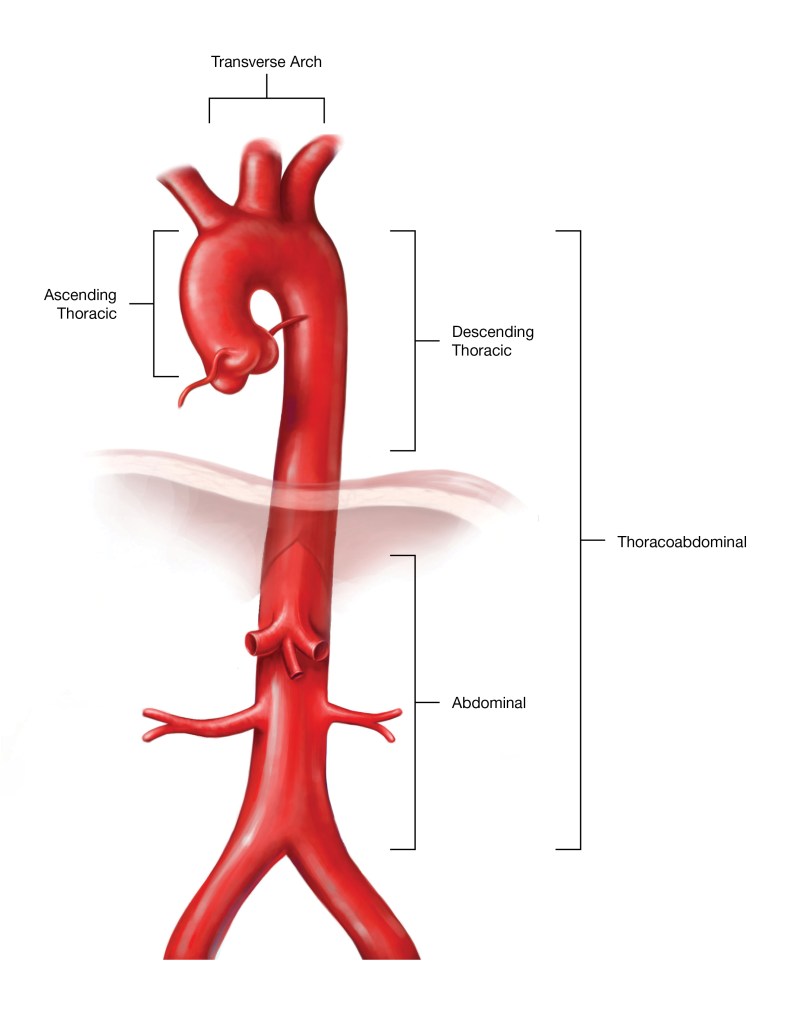
Aortic aneurysms vary greatly, and the timing and type of repair used often depend on where the aneurysm begins and ends. The various types are discussed below.
Types of aneurysms
Ascending aortic aneurysms
Ascending aortic aneurysms develop in the section of the aorta immediately above the heart. Repairing this type of aneurysm typically requires open surgery, which is most commonly performed by a cardiac surgeon. In some highly selected cases, these aneurysms can be treated with endovascular therapy.
Aortic arch aneurysms
Aneurysms in the aortic arch traditionally have been repaired with open methods, but newer endovascular methods are currently in development that allow for minimally invasive treatment of some of these aneurysms. Additionally, “hybrid” open and endovascular procedures are sometimes used to allow for a less invasive option than a traditional open operation. These procedures may require the involvement of both vascular and cardiac surgeons.
Descending thoracic aneurysms
Aneurysms in the descending thoracic aorta are most commonly treated with endovascular methods, but arterial anatomy and cause of the aneurysm may prevent a minimally invasive treatment from being used. Endovascular treatment of these aneurysms is often referred to as “TEVAR,” which stands for thoracic endovascular aortic repair.
Thoracoabdominal aortic aneurysms
Aneurysms that extend from the thoracic aorta through the diaphragm into the abdominal aorta are called thoracoabdominal aneurysms. These are often the most complex type of aortic aneurysm and carry the highest risks associated with repair. Depending on arterial anatomy and cause of the aneurysm, thoracoabdominal aneurysms may be treated with endovascular, open, or hybrid techniques.
Abdominal aortic aneurysms
Abdominal aortic aneurysms, often referred to as AAA, are the most common type of aortic aneurysm and develop in the section of the aorta below the diaphragm and within the abdomen. These aneurysms are most often treated with endovascular methods, but sometimes they must be treated with open surgery for various reasons, which your surgeon can discuss with you in detail. Endovascular treatment of AAA is often referred to as “EVAR,” which stands for endovascular AAA repair.
Aortic dissection
Advanced care and treatment approach
UAB Medicine’s multidisciplinary team of vascular and cardiac specialists provides expert care for aortic aneurysms and aortic dissections. Depending on the location and cause of the condition, treatment may include minimally invasive endovascular procedures, open surgery, medication when appropriate, or a combination of these techniques.
Our specialty-trained surgeons and physicians are leaders in their field and have extensive experience treating some of the most complex vascular diseases and conditions, including aortic disease. That expertise is backed by the latest and most advanced technology, facilities, and treatment options, as well as our dedication to patient-centered care.
As a major academic medical center, UAB maintains an active research program that also manages clinical trials. Our commitment to innovation and discovery often means that patients have access to advanced new treatments long before they are available to the general public.
Videos
Resources
- Adult Congenital Heart Association
- Division of Cardiothoracic Surgery
- Division of Cardiovascular Disease
- Division of Vascular Surgery and Endovascular Therapy
- Pediatric Cardiology
- The Marfan Foundation
Clinical Trials
Speak to your physician about your options and browse the link below for more information



Latest News
View All News-
Protect your heart health: Tips for the fall time change from UAB expert
October 14, 2026
-
UAB receives grant to investigate how genetics shape blood pressure response to salt
October 5, 2026
-
UAB doses world’s first patient in investigational gene therapy trial for BAG3-associated dilated cardiomyopathy
September 24, 2026
-
New multi-ancestry genetic score improves risk prediction for a common inherited heart muscle disease
September 14, 2026
-
Nine new genomic regions that control a critical heart biomarker uncovered by largest genetic study
June 18, 2026