
By Frank Ruggiero, UAB Medicine
In Birmingham, survival rates for out-of-hospital cardiac arrest cases lag behind national averages. But a new research effort at UAB Medicine is taking steps to close that gap – starting with a phone call.
UAB Medicine emergency physician Ryan Coute, D.O., is leading a pilot study aimed at improving the clarity and effectiveness of CPR instructions provided by 911 dispatchers. The study is backed by grant funding from the National Institutes of Health and the American Heart Association.
With support from UAB Clinical Simulation, the project is helping determine how best to guide bystanders through lifesaving CPR action in the critical moments before first responders arrive.
“Our research has shown that Birmingham’s bystander CPR rates are about two and a half times below the national average,” Dr. Coute said. “Only about three out of every 100 patients who suffer a cardiac arrest outside the hospital survive. We’re working to change that.”
Cutting-edge manikins
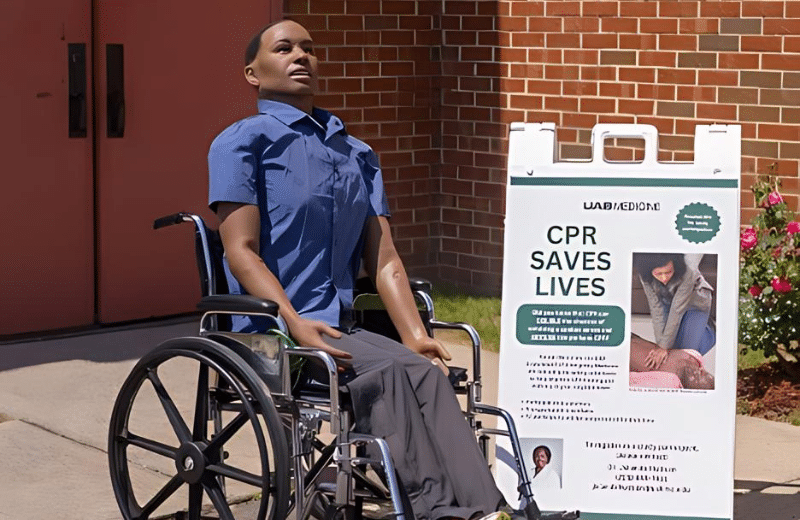
The team partnered with local churches to conduct simulations that felt like real life. This included cutting-edge or “high-fidelity” manikins that react like a human body in many ways. Participants entered a room to find the manikin “in distress”, and they were instructed to call 911. On the other end of the line, actual Birmingham dispatchers walked them through Alabama’s standard CPR instructions.
During the exercise, the UAB Clinical Simulation team captured data from sensors in the manikin that provide feedback on chest compression quality, including depth, rate, and duration.
“We’re now analyzing how effective that CPR was,” Dr. Coute said. “But even in these early stages, I’d say it was a massive success. Community members arrived excited, they took it seriously. One participant’s glasses fell off mid-compression, and instead of stopping to pick them up, they kept going. That’s exactly what we were hoping for – people treating the simulation like real life.”
In addition to tracking CPR performance, the team conducted focus groups with each participant afterward, to better understand how well the instructions worked in the moment. Feedback from those sessions will be used in revising Birmingham’s 911 CPR protocol in the future.
Rewriting the script
The project’s next phase will bring stakeholders together, including community participants, the Birmingham Fire and Rescue Service, and regional 911 agencies. They will form a collaborative “think tank” to rewrite the dispatch script and test it again based on what was learned during this study.
Dr. Coute says UAB Clinical Simulation is an important partner in both the technical and human elements of the project.
“They really went above and beyond to make sure this project was successful,” he said. “The equipment, the expertise, the flexibility – even running a Saturday session. You could tell they believed in the mission, and that meant a lot.”
Click here to learn more about simulation activities at UAB Medicine.