
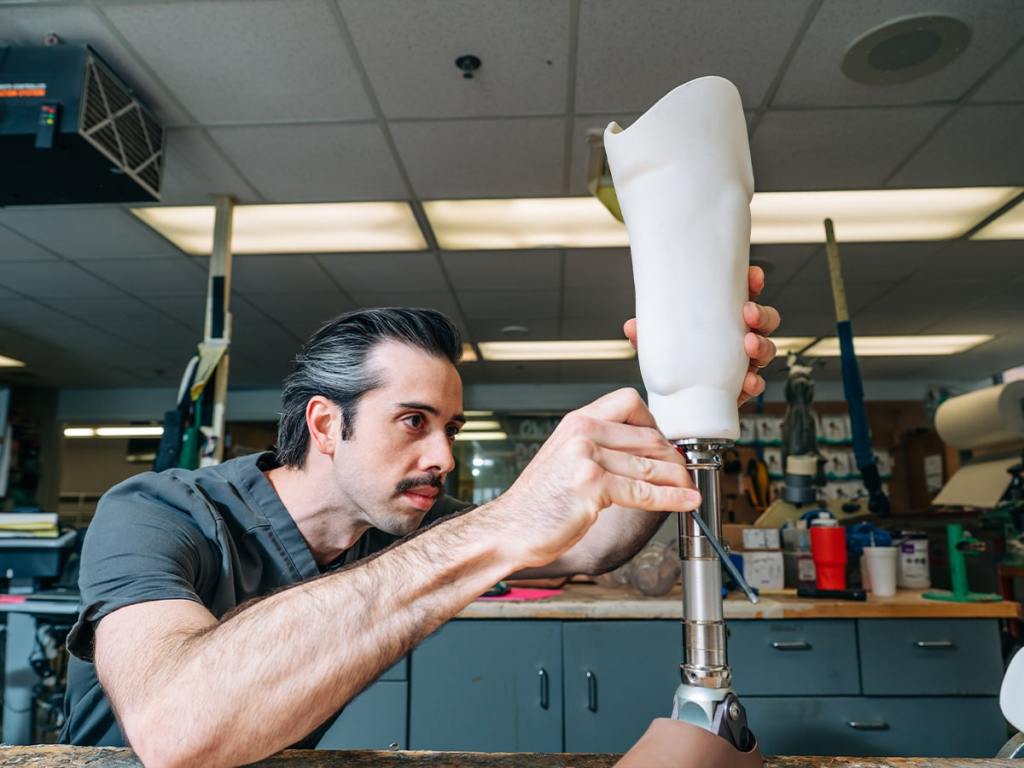
The UAB Amputee Clinic at Spain Rehabilitation Center is now the first clinic in Alabama, and one of few nationwide, to offer 3D-printed sockets for prostheses.
Conley Carr, M.D., medical director of the clinic and associate professor in the Department of Physical Medicine and Rehabilitation, shared that the 3D printer allows patients to receive prostheses faster and at a lower cost.
“If you look in the literature, it’s hard to find people doing this kind of work,” Carr said. “Only a small number of prosthetics clinics have integrated 3D printing into routine patient care, making UAB part of a limited group offering the technology.”
Nationwide, the demand for prostheses is growing fast. According to a study published in the Archives of Rehabilitation Research and Clinical Translation, the number of people living with limb loss in the United States will double by 2050, largely driven by predicted increases in vascular disease and diabetes.
3D printing process
Traditional methods to create prostheses can be labor-intensive and constrained to working hours, limiting how many the clinic can make each week. To combat this, the UAB Orthotics and Prosthetics Lab has been working on creating more digital operations.
The lab has utilized a 3D scanner and carving machine for many years now. It creates a digital file of a patient’s limb, which is sent to a carver that transforms the file into a shaped piece of foam.

“This took us halfway to our goal of a fully digital operation,” Carr said. “With the new 3D printer, the clinic can turn digital files from the 3D scanner directly into a finished socket.”
Brian Mueller, certified prosthetist and clinic director of the Orthotics and Prosthetics Lab, says each socket takes several hours to print, but the 3D printer can be left to run overnight or on the weekends. The 3D scanner can hold digital files created for each patient, meaning that replacements can be made quickly and can be a perfect replica each time.
“We have patients who have used the same socket for years and years want the exact same thing when replacing it,” Mueller said. “We can pull up the file and reproduce it exactly.”
Patient benefits
Carr and Mueller say the 3D printer helps patients receive sockets faster with a personalized fit, improving mobility.
“3D printing creates sockets tailored to each patient’s anatomy, improving comfort and reducing skin irritation and pressure sores,” Carr said. “Patients also receive them in days rather than weeks, accelerating rehabilitation.”
Carr and Mueller say the 3D printer will help create customized braces for patients who need orthoses.
“These can come from all over the hospital,” Carr said. “Someone who has had a stroke and has foot drop may need bracing for that foot, while patients from orthopedics or neurosurgery might require a spinal brace.”
As the clinic continues to expand, the printer will continue playing a role in meeting patient needs.
Written by: Matt Windsor and Katie Steele
Photos by: Jennifer Alsabrook-Turner
Source: UAB News