
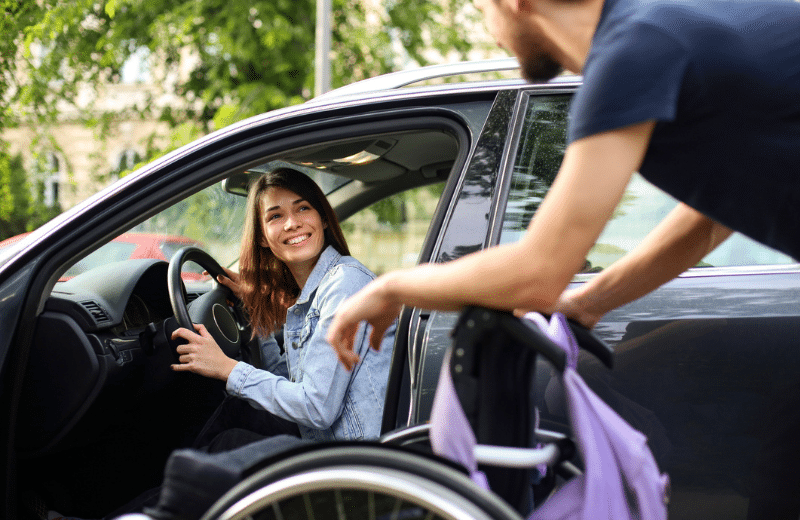
Being able to drive means freedom for many people, but that ability may be limited after certain injuries or medical conditions.
The Driving and Community Mobility Program at UAB Spain Rehabilitation Center was created to address this. For patients affected by physical, sensory, or mental processing impairments, the program can improve their quality of life by helping them safely regain as much independence as possible.
“For most people, driving is a top priority if they can never walk again,” said Mischa Jones, an occupational therapist and driving rehab specialist at UAB Spain Rehabilitation Center (Spain Rehab). “I’ve had paraplegics tell me that driving is the thing they love to do because people can’t judge them or see that they can’t walk until they get out of the car. It’s the one skill that makes them feel the most normal.”
The program is for patients recovering from major injuries or illnesses such as stroke, spinal cord trauma, neurological conditions, and age-related visual or mental processing issues. It can boost their sense of well-being and ability to live a more meaningful life.
First steps
Since it’s a rehabilitation program, it’s only for licensed drivers – not new drivers. The program begins by evaluating patients to determine their current driving ability and review their condition and driving history. Their vision, hearing, mental processing, and motor function are tested, and those who pass move on to a road assessment, so a specialist can observe their driving in a variety of environments and situations.
“When we go on a road assessment, whether they’re using equipment or not, our responsibility is to make sure that they’re safe – first in a parking lot, then in a residential area, in low city traffic, and in high city traffic,” Jones said. “If they want to drive the expressway, we can do that as well.”
The specialists work with patients to ensure that they have special adaptive equipment they may need, such as steering knobs, hand controls for the accelerator and brakes, and pedal extensions.
“The driving aids are endless,” Jones said. “Someone who has one arm may come in and be able to drive normally but could benefit from a steering aid and an extended accessory knob. So, instead of reaching for the blinker or windshield wiper controls, they can just press buttons on their steering wheel.”
Community mobility
For patients not able to drive at all, Spain Rehab also offers community mobility support as part of the program. This includes educating patients on other transportation options for getting around in their communities.
“Years ago, we faced the fact that Birmingham doesn’t really have viable transportation for people with disabilities,” Jones said. “Some people weren’t able to go through the driving program, so we began exploring ways to connect them with mobility options available in their communities.”
This support is customized to patients’ abilities, where they live, and what services are available to them. For some, the solution may be taking the bus or using rideshare services such as Uber and Lyft, while others may choose to have a licensed caretaker drive them. Specialists can ride along with patients to help them better understand how to use various services and get where they need to go.
“If you are not able to drive, you still have to go to the store, so we work on finding resources to help you do that,” Jones said. “Sometimes their goal is just to go to a few places in the community, so we can set their goals based on their needs and tailor our support to each individual patient.”
Since Jones joined the driving program in 2008, its popularity helped it grow into a full-time program that serves patients from across the region. “There’s nothing that compares to the smiles on their faces,” Jones said. “It’s a success for me that I get to see that.”
November is Assistive Technology Awareness Month. To learn more about UAB’s Community Mobility and Driving Program, please call 205-975-4922.