
Pregnancy and cancer are two of the most life-changing health events. Those who face both at the same time depend on specialty care coordinated with a personalized approach.
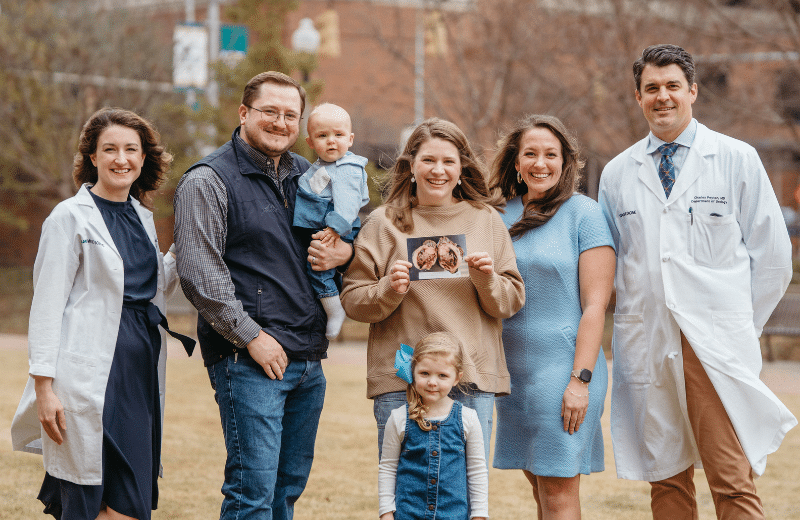
Heidi Neas was 16 weeks pregnant when she was referred to UAB Medicine for answers following abnormal genetic test results. Maternal-fetal medicine (MFM) and cancer specialists worked together to discover and safely remove a kidney tumor that threatened her life and her pregnancy.
Abnormal screening results
The test that began Neas’ cancer journey was one routinely offered to pregnant women. Cell-free DNA screening, also called noninvasive prenatal testing (NIPT), analyzes fragments of DNA that originate from the placenta and is used to detect disorders such as Down syndrome. Neas, 33, of Huntsville, already a mother of one, was 16 weeks into an otherwise healthy pregnancy and had no reason to be anxious about the test.
Her result was concerning for multiple different chromosome abnormalities, which providers have learned can indicate maternal cancer. This is because, like the placenta, cancers can also shed fragments of DNA into the bloodstream. Following these results, Neas’ local OB/GYN, Karen Raiford, M.D., quickly referred her to UAB Medicine’s Maternal-Fetal Medicine Clinic. MFM specialists treat high-risk pregnancies and patients who require specialized monitoring and care.
A lifesaving scan
MFM physician Carolyn Webster, M.D., and genetic counselor Olivia Kesler met with Neas. “I didn’t know what to expect, but they were very calming and direct. I already knew cancer was a possibility with abnormal results,” Neas said.
“My job was to walk through what the test was showing, what it might mean, and what next steps we could take. That includes offering confirmatory tests for the baby, but also thinking about maternal health,” said Kesler, who works in some of UAB’s cancer clinics in addition to MFM. In their discussion of family health history, Neas mentioned that her father had kidney cancer later in life. “At the time, I wasn’t too struck by that,” Kesler said. “My famous last words were, ‘This family history of kidney cancer is probably not related.’”
Neas had registered to participate in a National Institutes of Health (NIH) study for patients with test results such as hers, which would include a full-body MRI scan. However, it would be several weeks before she could receive a scan through that study, and waiting would only increase whatever risks she faced.
“We reviewed the most common cancers seen in pregnancy, but she had no symptoms, exam findings, or risk factors, and her blood work was otherwise normal,” Dr. Webster said. “Even though kidney cancer is very rare in young women, her family history gave me pause. I couldn’t shake the idea that we needed to look at her kidneys. So, I made the decision to go ahead and offer to scan her kidneys using an ultrasound during same visit.”
Neas recalled, “We could have waited for the NIH scan. But I was there, and I just felt like I needed to know, so we did it, and that changed everything.”
The scan revealed a large mass in her kidney, ending weeks of uncertainty and allowing her care to move forward quickly. “Identifying the mass allowed us to expedite her care,” Dr. Webster said. “We transferred her directly to the UAB Women and Infants Center Maternal Evaluation Unit for targeted imaging and direct coordination with the oncology and urology teams.”
Neas received answers the same day instead of weeks later. The 11-centimeter tumor was cancer. Fortunately, there were no indications that the cancer had spread.
Weighing the risks
Charles Peyton, M.D., a urologic oncologist at the UAB O’Neal Cancer Center, became part of her care team, leading the cancer treatment. Coordinated care was essential to maintaining a healthy pregnancy. “We presented her case at our tumor board — not just because it was rare, but because we had to make sure everyone was aligned: OB, urology, anesthesia, oncology,” Dr. Peyton said. “A pregnant patient with a suspected malignancy isn’t something we take lightly.”
“We had several conversations between MFM and Urology to talk through what would give her the best chance at a healthy pregnancy and a good cancer outcome,” Dr. Webster said.
They weighed the risks of surgery to baby and mother versus waiting for postnatal care. At 22 weeks, the growing uterus is just below the kidneys, but surgeons could still carefully navigate around it to avoid disrupting the pregnancy. The team settled on prompt surgical removal of the tumor as the chosen approach.
“I could tell they were familiar with the risks, and the best path was clear to the team. That gave me a lot of confidence,” Neas said. “Dr. Peyton walked me through everything. He made it feel manageable. He helped me weigh the risks, and he talked about the anatomy and the best timing,”
Dr. Webster made sure Neas never felt alone in dealing with the emotional side of treatment. “Our job includes guiding patients through uncertainty,” she said. That personal connection was important to Neas, who said “it wasn’t just medical – they cared how I was doing emotionally, and about my family.”
Surgery and follow-up
Three weeks after her first visit to UAB Medicine, Neas had an open nephrectomy, which is surgical removal of the affected kidney containing the tumor. “We achieved an R0 resection — that means no residual tumor, no need for radiation or chemo,” Dr. Peyton said. “That’s the best-case scenario for a tumor like this.”
Neas remembers waking up dazed and asking first about her baby. “They said he was fine – that’s all I needed to hear,” she said.
Neas was in the hospital recovering for five days, sore but gradually able to move around. “We continued to monitor her very closely, and both she and baby did really well,” Dr. Webster said. “We followed her monthly to ensure baby was growing and that vitals and labs were stable. She stayed on track, and we gave her the green light to deliver locally with her OB/GYN.”
Neas was thankful to return home with the backing of her specialty team. “They didn’t just hand me off,” she said. “Even when I went back to my regular providers, they kept checking in, and I never felt like I was on my own.”
She was relieved at the level of ongoing collaboration between her referring OB/GYN and the UAB Medicine team. “Everyone coordinated,” Neas said. “I never felt like one part of my care didn’t know what the other part was doing. It was all connected.”
Her son, Abram, is “healthy and perfect,” she said. As for Neas, she continues to follow up with UAB Hematology and Oncology, and all tests to date indicate that she is cancer-free.
Media inquiries can contact Tehreem Khan 205-807-2124 or tkhan1@uab.edu.