
Parkinson’s disease can lead to dysarthria and dysphonia, which are difficulties with speech and voice, respectively. That is because Parkinson’s can impact respiration, the use of the voice box, and the precise movements of the tongue and throat muscles required for clear speech.
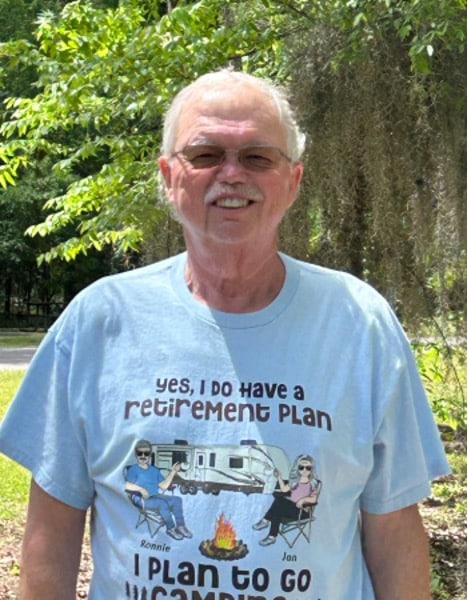
After Ronnie Hamilton of Helena, Ala., was diagnosed with Parkinson’s disease in summer 2024, he did not communicate the same way he used to.
“I would just go sit at the church and wouldn’t talk a lot,” Hamilton said. “Unless I just forced myself to talk, I was kind of ignored. I guess people don’t hear you.”
Doing “everything with intent” is a phrase emphasized in the SPEAK OUT!® Therapy Program. Thanks to a grant from the Parkinson Voice Project, co-principal investigators Sarah Hoch and Edie R. Hapner, Ph.D., speech-language pathologists at the UAB Voice Center, are able to offer SPEAK OUT! Therapy free of cost to eligible people with Parkinson’s disease.
“I’m healthier now,” Hamilton said. “I can talk better, I can think better, and I do everything with intent now.”
Hamilton heard about SPEAK OUT! Therapy while attending a local Parkinson’s disease support group. He then started attending regular SPEAK OUT! Therapy sessions with UAB Voice Center clinicians.
“Communication is a key component in our ability to effectively participate in daily life and to build and maintain meaningful relationships,” Hoch said. “Furthering research and improving access to speech/voice therapy for a population with an already high healthcare burden is very important to us at the UAB Voice Center. We care so much about our patients.”
The importance of exercise
In terms of speech and voice, Hamilton says the therapy has taught him how to better manage breath support for speech via exercises that move his tongue, lips, throat, fingers and chest.
“When I speak, I make sure to get enough air to breathe,” Hamilton said. “And then just have a full sentence – get it all the way out.”
The voice and speech training has taught Hamilton how to put emphasis on words and strengthen his speech by drawing out syllables. Participants do exercises that focus on saying words and how words are spoken.
“I can actually have conversations now without worrying about them not hearing me or understanding what I’m talking about,” he said. “Before, I wasn’t moving my lips. I was kind of just whispering. My wife says she can hear me 10 times better now. We have more conversations and more communications.”
According to Hamilton, 68, clinicians have told him that air capacity has improved since he started SPEAK OUT! Therapy and now is more like that of a person younger than 60. It has helped him strengthen his vocal muscles, which also improved his swallowing.
“Before, when I ate dinner at night or any time, I was having to choke, having to cough,” Hamilton recalled. “Now, I don’t do that at all, because I have the voice training. I don’t feel like I’m going to get choked all the time.”
Exercising his voice has, in turn, prompted him to strengthen his facial muscles, combating another common Parkinson’s symptom called hypomimia, or reduced facial expression.
“They actually showed me videos yesterday of what I was four months ago and what I am now,” Hamilton said. “And my voice box, the little thing on top, was actually closing all the way, and it had grown a little bit. It got stronger because I’ve been using it.”
Another benefit? He’s smiling more.
“Before, my face was kind of a frown all the time,” Hamilton said. “Now, I notice that I grin more.”
As Hamilton reflects on his diagnosis and how SPEAK OUT! Therapy and the UAB Voice Center have helped transform his life, he says it is all about one thing.
“When I breathe, I breathe with intent,” he said. “When I get up, I walk with intent. I think with intent now. Everything I do – it has a reason behind it.”